
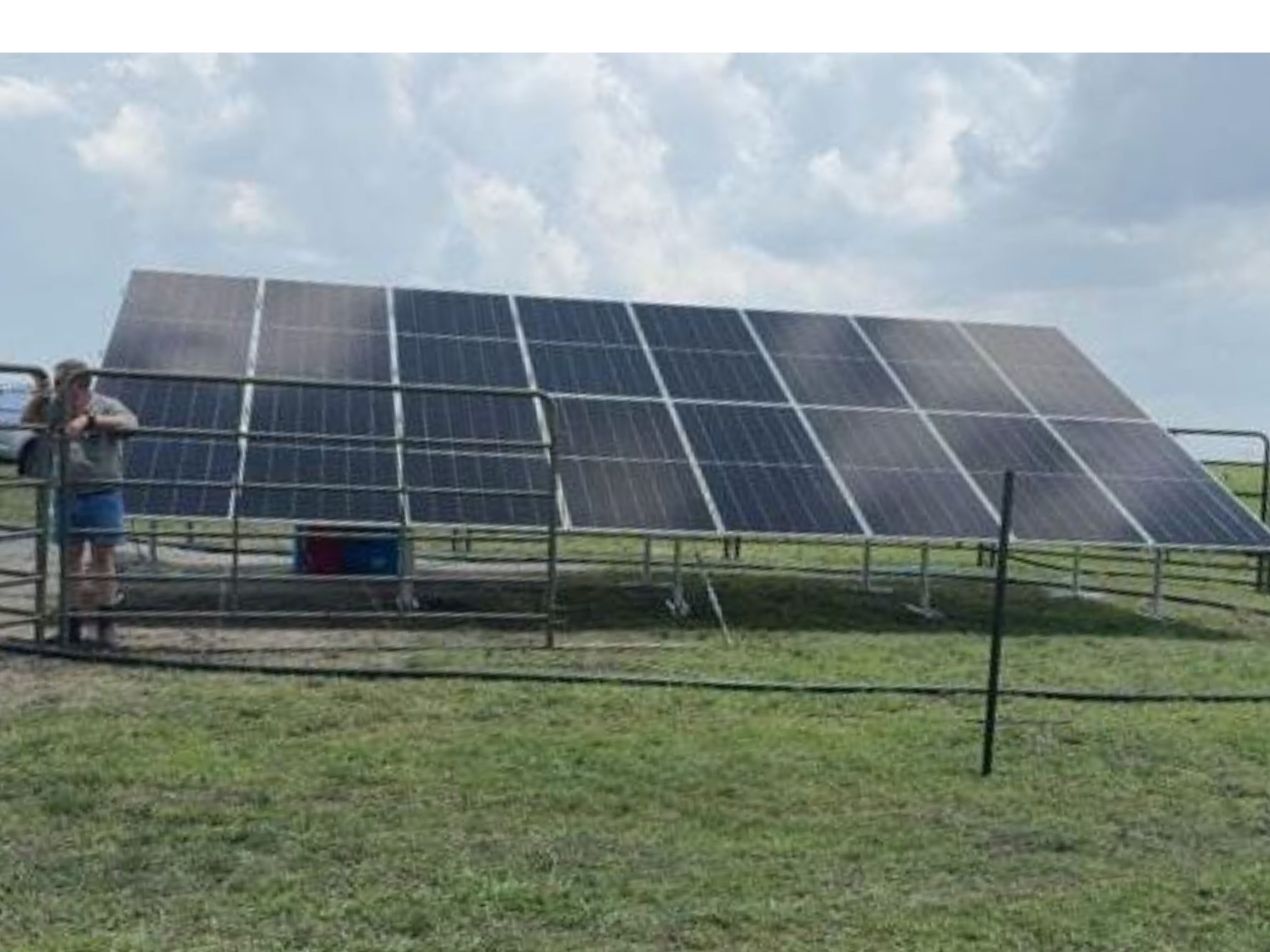
For most farms in inland South Africa, irrigation is the single biggest line on the electricity bill. And it's also the load that lines up best with the sun — pivots and drip systems run hardest in daylight, the exact hours solar produces. Done well, solar irrigation eliminates diesel runs, slashes the grid bill, and pays itself back inside three years.
Why irrigation pumping is the perfect solar load
Three reasons make irrigation the cleanest, fastest-payback application of solar on a farm.
Daytime duty cycle. Pivots, drip lines and most borehole pumps run from sunrise to sunset. That's exactly when solar produces. You don't need expensive battery storage — the panels go directly into a variable-speed drive (VSD) inverter, the inverter drives the pump, and you're done.
High electricity intensity. Pumps draw a lot of power. A 7.5kW borehole pump running 8 hours a day on Eskom adds about R7 000 to the monthly bill at current commercial tariffs (around R4.10/kWh blended). A 22kW pivot pump can exceed R20 000/month easily.
Diesel backup is exhausting and expensive. Many farms run diesel pumps where the grid doesn't reach. At R23/litre, a 30kW diesel pump consuming 12L/hour costs over R8 000 a day to run. Solar eliminates the fuel entirely, and removes the daily routine of refuelling, oil changes and generator maintenance.
The three solar irrigation approaches
We design around three configurations, depending on the farm's load profile and whether the grid reaches.
1. Direct-drive solar VSD pump (no batteries)
The simplest, most cost-effective setup. Solar panels feed a variable-speed drive (VSD) inverter, which controls the pump motor directly. As cloud cover changes, the VSD slows or speeds the motor smoothly — the pump just produces less water on a cloudy hour, not zero.
Best for: standalone borehole pumps, dam-fill installations. Anywhere you don't need 24/7 operation.
Equipment: Solar VSDs from Freecon, INVT and other tier-1 brands. We size the PV array at 1.3–1.5x the pump's nameplate rating to allow for irradiance fluctuation.
Indicative cost: R45 000 – R200 000 for a 5kW – 16kW pump system. Payback typically 18–36 months and can replace dedicated Eskom Connection or Diesel Generator.
2. Solar-grid hybrid (grid-tied with solar boost)
Where the pump is already on Eskom, we add a solar array that feeds the same circuit. The pump draws from solar by day and grid at night or in poor weather. No battery — Eskom is the battery. Section 12B applies, so 100% of the install is deductible in year one.
Indicative cost: R13 500 – R15 000 per kWp installed. A 25kWp solar array on a 22kW pivot pump costs around R325 000 – R375 000 before the tax saving brings it down to roughly R245 000 effective.
3. Solar-diesel hybrid (off-grid farms)
For remote pumps where the grid doesn't reach but you want 24/7 reliability. Solar plus a battery for evening pumping, with a backup diesel generator for extended cloudy periods. Sized to minimise diesel hours rather than eliminate them entirely.
How we size a solar irrigation system
The shortcut answer: solar PV array kWp = pump motor kW × 1.3 to 1.5.
That oversizing factor accounts for solar irradiance variation, panel temperature derating, system losses and the fact that VSDs operate most efficiently at 70–80% of peak input.
So a 7.5kW pump needs a 10–11kWp solar array. A 22kW pivot pump needs roughly 30kWp.
We also right-size the VSD to match the pump's locked-rotor torque, not just its running power — that's where a lot of cheap installs go wrong, and you end up replacing the inverter inside 18 months.
A real example — 7.5kW pump, Wolwehoek
We installed a direct-drive solar VSD on a 7.5kW borehole pump in Wolwehoek, Free State. The client had to make a choice of either a new Eskom Connection or Diesel Generator. The pump pumps +- 12m3 per hour and fills two 30 000l dams.
System: 10kWp Longi Solar array, INVT 16KW solar variable speed drive, 7.5KW Pump no battery.
Before: R6 000 – R9 000 per month in diesel, plus generator wear or a +-R 15 000 Eskom bill.
After: Zero fuel cost during daylight hours. Pump runs autonomously, no operator intervention needed.
Indicative payback: 18–24 months on diesel savings alone.
When solar irrigation is the right move
If you tick any of these, an assessment is worth the call:
- Pump runs predominantly during daylight hours
- Currently on diesel (R23/L adds up fast)
- Monthly Eskom pumping cost above R5 000
- Pivot or borehole pump rated 1.5kW or larger
- You'd value not having to refuel mid-irrigation
If pumping is only a tiny part of your bill, or runs almost entirely at night, solar pumping isn't the best place to start — we'd point you at battery storage instead.