
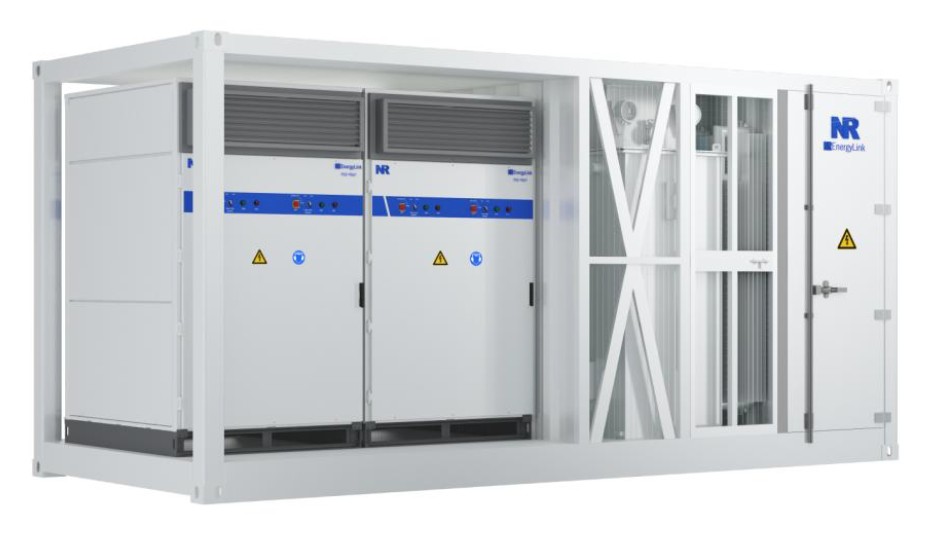
QES has signed on as an official South African dealer for NR Electric — one of the world's top grid-scale energy storage and power conversion equipment manufacturers. This opens the door for QES to deliver utility-scale Battery Energy Storage Systems (BESS) for large industrial, commercial and Independent Power Producer (IPP) customers across SA. Here's what the partnership unlocks and what the two flagship NR Electric products actually do.
Who is NR Electric?
NR Electric Co., Ltd is a Nanjing-headquartered power technology company, part of the NARI Group (originally the Nanjing Automation Research Institute under State Grid China). Founded in 1995 and listed on the Shanghai Stock Exchange, NR Electric is one of the top three protection-relay manufacturers in the world, with significant credentials in HVDC and FACTS systems, DC grid technology, and grid-scale battery storage.
Their kit is installed in major provincial grid projects across China, in HVDC backbones connecting renewable energy zones to load centres, and in utility BESS deployments in roughly 80 countries. In a sector that's seen plenty of Chinese entrants of varying quality, NR Electric sits firmly in the tier-1 group — engineering-led, certification-heavy, and built for installations where downtime carries real financial and grid-stability consequences.
For QES this dealership is a meaningful step. It signals that we're now equipped to deliver BESS projects at the megawatt-hour scale — well beyond the 50kW–2MW commercial range that's been our public positioning. If you're a large industrial, agribusiness, mining or IPP customer, these are the products that make hybrid solar-plus-storage projects realistic at your scale.
The two flagship products
PCS-8812-2500-5015 — 5 MWh integrated BESS container
This is NR Electric's all-in-one battery storage container. A standard 20-foot shipping-container form factor, pre-assembled and pre-tested at the factory, that arrives on a truck ready to be lifted onto a foundation and commissioned. Inside one enclosure you get the entire BESS stack: battery modules, Battery Management System (BMS), liquid-cooled thermal management, fire suppression, and the AC/DC integration plumbing — all certified as one system.
The key technical specs:
- Nominal energy: 5 015 kWh (5 MWh) — enough to run a 1 MW industrial site for 5 hours, or shave the evening peak demand on a much larger operation
- Nominal power: 2 500 kW (2× 1 250 kW PCS units) — high power-to-energy ratio supports both energy arbitrage and fast-response peak shaving
- Battery chemistry: LFP (lithium iron phosphate) 314Ah cells, 1P416S × 12 architecture — LFP is the safest, longest-cycling lithium chemistry available, ~6 000 cycle rated
- Cycle efficiency: ≥94% — only ~6% of the energy in is lost in the round-trip out
- DC voltage range: 1 050–1 500 V — high-voltage architecture reduces current and resistive losses
- Fully liquid cooled — keeps cell temperatures in the optimal band even at +45°C ambient, extending battery life significantly versus air-cooled alternatives
- Operating range: −30°C to +55°C (derating above 45°C) — comfortably covers any SA ambient
- IP55 enclosure + integrated gas-extinguishing fire suppression with smoke and temperature detection
- Communications: CAN, RS-485, RJ45, optical fibre. Protocols: Modbus, IEC 61850, IEC 60870-5-103
- Certifications: IEC 62619, IEC 63056, IEC 61000, IEC 62477, IEC 62933, UN 38.3, UN 3536 — covers safety, transportation and grid interconnection requirements
Single-container size: 6 058 mm × 2 438 mm × 2 896 mm (a standard 20-foot footprint), 41 tonnes. Multiple containers can be stacked or paralleled for larger projects — a 25 MWh deployment is simply five containers side by side.
PCS-9567MV-5000 — 5 MVA medium-voltage skid
This is the grid-side companion to the BESS container. The PCS-9567MV is an integrated medium-voltage skid that bundles the Power Conversion System (PCS), step-up transformer and MV switchgear into one factory-assembled 20-foot container. It takes the 690V AC output of the PCS and steps it up to 6.6–33 kV — making it directly grid-tieable on most South African utility connections.
Key specs:
- Rated power: 5 000 kVA (5 MVA) with optional 4 000 kVA configuration
- MV operating voltage: 6.6–33 kV ±5% — covers Eskom and municipal MV distribution standards
- PCS efficiency: 98.7% at DC 1200V under IEC 62933-2-1 conditions — among the highest in the market
- Total Harmonic Distortion: <3% — keeps the BESS in compliance with NRS 048-4 grid interconnection requirements
- Four-quadrant operation — can absorb or supply both real (kW) and reactive (kVAr) power independently. That's what makes the system capable of grid-forming, frequency regulation, voltage support and L/HVRT and L/HFRT ride-through
- State-of-the-art three-level technology — lower switching losses, smoother output waveform
- Power factor range: >0.99
- Protection: DC disconnector + fuse inside the inverter, AC motorised circuit breaker, surge arrestors on DC and AC, ground fault protection (DC IMD as standard, AC IMD optional), transformer pressure/temperature/gas protection, fire suppression
- UPS: standard 1 kVA / 15 min for control electronics; 1 h and 2 h options available
- Operating temperature: −35°C to +60°C, derating above 45°C
- Altitude: up to 5 000 m, derating above 3 000 m
Single skid size: 6 058 mm × 2 896 mm × 2 438 mm, 24.3 tonnes. The two products are designed to be paired — each 5 MWh BESS container connects to one 5 MVA MV skid for a complete grid-tieable installation.
Why this matters for South African customers
The South African grid has two structural problems that BESS solves at scale: reliability (load shedding, planned outages, line drops) and cost (Eskom tariffs up 24% in three years, demand charges that punish peak consumption). For a large customer — think a packhouse cold chain, a metals processor, a shopping precinct, a mining operation — these aren't theoretical problems. They're a real monthly line item and a real operational risk.
The NR Electric range unlocks three project types we couldn't realistically deliver before:
1. Behind-the-meter peak shaving for large industrial customers. If your business pays significant demand charges (R/kVA), a 5 MWh / 2.5 MW BESS shaves your peak load every day. Even without solar, the saving on demand charges alone can deliver a 5–7 year payback. Add solar and the maths gets much better.
2. Hybrid solar + BESS for energy-intensive operations. A 2 MW solar PV array paired with a 5 MWh BESS lets a heavy industrial user offset most daytime load with solar, store excess for evening operation, and run through routine grid outages without disruption. Section 12B applies to the full system value.
3. IPP and wheeling-ready projects. South Africa's regulatory framework now permits private generation up to 100 MW without a NERSA licence (post-2023 amendments) and supports wheeling — moving generated energy from one Eskom connection point to another. A grid-forming 5 MVA installation, properly engineered, can serve as the storage element in a multi-site corporate solar wheeling deal.
The economics — order-of-magnitude
BESS economics are heavily dependent on tariff structure, demand profile and the specific use case. As an order-of-magnitude reference for SA in 2026:
| Project type | Indicative size | Typical payback |
|---|---|---|
| Peak shaving (demand charge only) | 5 MWh BESS | 5–7 years |
| Solar + BESS (commercial industrial) | 2 MW PV + 5 MWh BESS | 3.5–5 years (with Section 12B) |
| Multi-site wheeling project | 10 MW PV + 25 MWh BESS | 4–6 years (IPP structure) |
| Standalone backup for cold chain | 5 MWh BESS, no solar | 7–10 years (depending on diesel offset) |
These are project frameworks, not quotes. The actual payback depends on your demand profile, your tariff structure (Megaflex, RuralFlex, Time-of-Use, etc.), the structure of any wheeling agreement and your specific grid connection point.
What being an SA-based dealer means in practice
Utility-scale BESS isn't a kit you order on a website. It's a multi-month engineering, procurement and construction project with significant grid-interconnection complexity. Being NR Electric's South African dealer means QES brings:
- Local pre-sales engineering. We size the system, model the economics against your specific tariff and operation, and produce the engineering package that goes to NR Electric in Nanjing for manufacturing
- NERSA, NRS 048 and grid-code compliance work. South Africa's interconnection rules differ from international standards. We handle the regulatory paperwork end-to-end
- Project management through installation and commissioning. Including coordination with Eskom or your municipality, civil works for the container foundations, MV cabling and earthing
- Local first-line technical support. Most BESS faults are resolved through configuration changes accessible via the cloud platform; for the rare physical intervention, we have local technicians who don't require a service ticket to Nanjing to access spares
- Direct access to NR Electric's R&D and field-engineering teams for the projects that warrant it
Is this the right product for your business?
If your monthly electricity bill is over R300 000, or your demand charges (R/kVA) exceed R100 000 per month, or you're a grid-connected operation where downtime costs you measurably each year, an NR Electric BESS is worth modelling for. If your monthly bill is under R100 000, we'd point you at our standard commercial solar + smaller storage options instead — the NR Electric containers are oversized for that load profile.
Send us your last three utility bills (full breakdown including demand charges and Time-of-Use periods), a brief description of your operation and your daily / weekly load profile if you have it. We'll come back inside 48 hours with an indicative system sizing, an installed cost range and a payback estimate framed against your real tariff structure.